Am I really going to do this? I thought as my computer pointer hovered over the “book reservation” button on a hotel website. “Oh well, here goes nothing” I said as I clicked the mouse. This was not the spring vacation I had planned. Originally, I wanted to go to Florida. However, when a friend suggested birding in Brazil, I thought it best to avoid two financially demanding trips in the same year.
Additionally, going to Florida and Brazil would mean I couldn’t visit my parents who live in Illinois. As a kind of built-in obligation of being their offspring, it is best to darken their door at least once a year.
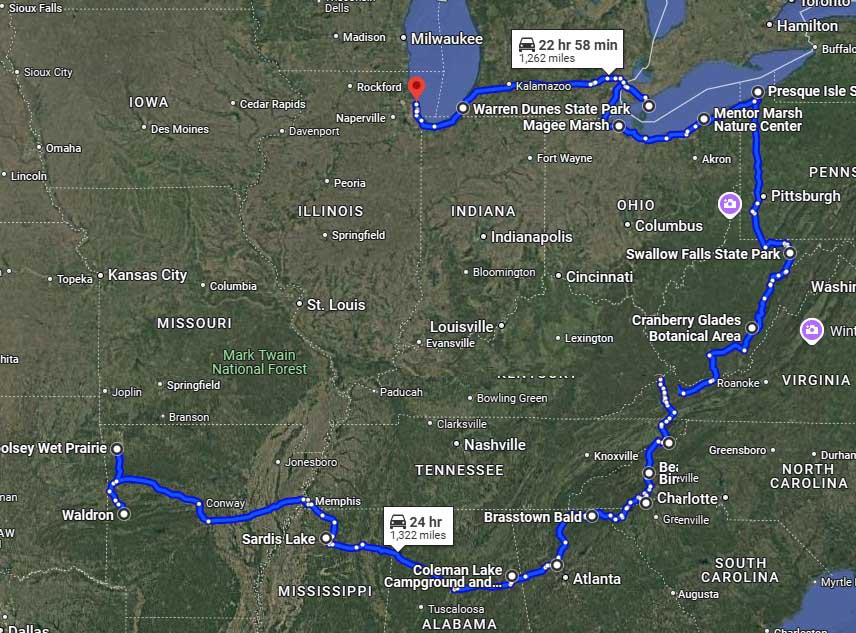
However, seeing the southern states now would make future vacations easier to manage. It meant that when the Florida trip did happen my focus could be solely on that state. So the problem was, how do I go to the Midwest and also log some of those southern states that were originally part of the Florida trip. I began to scheme to try and fit all of these objectives into a single trip.
As I was mapping my way through the south, certain locations began calling my name as must-see destinations and my ambition soon got the better of me. This was not a smart plan (my plans rarely are), but it did give me a chance to get considerably closer to my goal of logging a complete checklist in every state.
The idea for this trip was the easy part. Planning it was rather difficult. My route had to go through 16 destination states and Canada, covering 4000 miles in 10 days. Trying to find birding locations on an ideal route coupled with hotels and restaurants was a daunting task. The timeline for each day would be altered multiple times before I was done. I had to plan out every minute. I needed to know how long the drives between locations would take, how long I was going to bird at each place, when restaurants would close, and so on. It was ridiculous, but after a few weeks of intense planning I was ready.
A couple days from the start of my vacation, I made one last minute change. Originally, I was going to drive straight through from Colorado to Arkansas, but a bird altered my plan. Instead, I left after work and overnighted in Kansas. A Tropical Parula was hanging out at a place called Dillon Nature Center and it was directly on my way south. The year prior I had hoped to see this bird in Texas but there were no sightings. I never imagined that this species would show up in Kansas. I don’t think anyone did. The fact that it was nest-building made it all the more odd. Still, I had my first lifer (L1) for the trip.
Dillon Nature Center – https://ebird.org/checklist/S236442580
Arkansas
I want to take a moment to mention that, as a queer person, I had a fair amount of trepidation about birding in the south and the midwest. I was raised in one of these areas and left for a reason. Racism, homophobia, and misogyny can run wild in these parts. Last I knew, near my hometown there was still an active Ku Klux Klan group. Some people in these parts have a thin veneer of nicety but when the conversation deepens one can never be sure what awaits.
Five minutes after crossing the state line into Arkansas I saw my first, and thankfully only, instance of racism. A truck driver, who was a person of color, had broken down on the side of the road. He was walking next to the road when a diesel pickup in front of me made sure to belch out soot around him in a dark cloud. It was a stark reminder of the cruelty that was condoned here. As a queer person, I knew I wasn’t safe. I was a target for bigots. However, I have the privilege of being able to stay below the radar. If I chose to keep my mouth shut (which is never a certainty when it comes to injustice) no one would even know they were talking to a trans person much less have the time to marshall their insecurities into action.
After this disheartening incident, I wearily plodded on to Woolsey Wet Prairie. The photos online made it seem as if this location was just a field with some grass. Luckily, it was so much more. I love birding wet prairie environments, especially when they include ponds and stands of trees. This one, surprisingly, had them all. The possibilities felt wide open.
My first footfalls into the prairie were met with the songs of Louisiana Chickadees, swallows, and Song Sparrows. Nearing the ponds I stumbled onto a number of Green Herons. Out into the drier portion of the prairie there was a Clay-colored Sparrow that gave me my best (and only second) photo of this species.*
Heading back toward the tree lined portion of the grounds I saw a couple of Swamp Sparrows and encountered some old growth cottonwood trees that held a number of warblers. American Redstart, Black and White, and Bay-breasted were among them. I stood here far longer than I care to admit trying to find these birds.
Within another fifty yards, there was a small brown bird flitting around in some undergrowth. I was certain it was a Northern House Wren but wanted to verify. As I was watching the wren it passed behind another bird, a Black-billed Cuckoo. I had prepared myself for a trip where this bird was missed entirely and here it was on day one. True to field guide descriptions, it was sitting motionless in some dense undergrowth. Had I not taken interest in the wren I would have never found the cuckoo. Lifer number two (L2) was in the books.
Woolsey Wet Prairie – https://ebird.org/checklist/S236672781
As I arrived at the hotel for the night in Fayetteville, I had a conversation about birding with the valet. He worked for a news company, during the 90’s, when the commotion about the discovery of an Ivory-billed Woodpecker was happening (spoiler alert, it is still extinct). My favorite documentary is about this occurrence. It’s called “Ghost Bird” (you can find it on youtube). What makes it great is the interviews with the people. It’s a snapshot of a struggling town grasping onto anything that might bring a sliver of prosperity. It is a hidden ode to the economic wasteland that corporations created when they abandoned small towns and moved to cities. It is also much more than that but the message of hope is what resonates with me. I highly recommend it.
I was pleased to meet someone who had a front row seat to this event. It would have been nice to drive through the town of Brinkley, the epicenter of the Ivory-billed drama, just to say I had been there. I missed having the flexibility for side excursions such as this. My trip was laid out to cover as many states as possible in ten days and nothing more. Perhaps that trip could happen another time.
Before the sun came up the next morning, I pointed the nose of my truck south towards the Ouachita National Forest. The target was a trifecta of birds in the form of a Red-cockaded Woodpecker, Brown-headed Nuthatch, and a Bachman Sparrow. The right habitat for the sparrow consisted of tall old growth pine trees coupled with a grassy forest floor. If I could find that habitat then all three species would likely be present. Habitat loss, generally in the form of logging, meant that the sparrow, and especially the woodpecker, are gradually exiting this world. I wanted to see them now before this task becomes more difficult, or even impossible.
The fact was not lost on me that the same area of the country which had extirpated the Ivory-billed Woodpecker was primed to drive even more species to extinction. Worse yet, it was from the same activity of deforestation and logging. The south had 81 years since the extinction of the Ivory-billed to get its shit together and it has largely failed. This is a shame because these states have some truly beautiful examples of nature’s bounty at their fingertips. They have set the stage to appreciate it only after it is gone.
I was hoping to use a great document I had found on the National Forest Service website. It detailed every stop on Buffalo Road in which to look for the woodpeckers and included the mileage for each nesting area. It was such a wonderful tool to have. Upon arrival, I discovered that the link to this document no longer worked. A search turned up nothing usable. It appeared as if the document had been removed from the website.
Given the president, Donald Trump’s inexorable insecurity, maybe the bird was too black for his comfort. I would just have to figure out where to go on my own.
After five or so miles and a couple of splashes through creek crossings I encountered the type of timber I was looking for. A controlled burn had recently been done here. There was spray paint marking trees in these burned areas and I hoped it wasn’t for logging. The obliterated ground vegetation made for easy walking. It was definitely birdy with numerous Kentucky warblers and vireos calling, but none of my desired trifecta. Luckily, there were numerous Prairie Warblers (L3) singing loudly and after much searching I was finally able to get a visual of one. Sound alone will suffice for a lifer while on vacation, but I’d rather see the bird.
After searching a few burned areas, I began to realize that, while vital to maintaining this habitat in the long run, the controlled burn had temporarily pushed the trifecta away from these areas. I decided to drive farther down the road. It wouldn’t make sense to burn the entire place at once. There had to be an area left unscathed. Finding such a place should better my chances at locating these birds.
A few miles later revealed an undisturbed forest floor. It just happened to be by an interpretative sign. Most likely this was one of the stops that was detailed in the now inaccessible online document. I walked up into the woods but just barely. All the usual suspects were calling but none of my trifecta. As I turned around to leave Merlin lit up with a Bachman Sparrow.
I didn’t hear the call. However, this hadn’t happened in the other locations which led me to believe that it was not a mistake. Now to find it. I listened to the bird calls as I watched Merlin light up. I was eventually able to learn which call belonged to the Bachman Sparrow (L4). I began slowly moving toward the calls. My caution was warranted. Upon approach, the bird would flush each time to the other side of me before I could find it perched. The sparrow never flew far so I surmised that its individual territory is relatively small. It took me some time to learn that this bird preferred a certain height from which to sing. It would fly from the lower branches of tall pines or the upper branches of forest floor vegetation (about 10-20 feet off the ground).
While I was searching for it. I kept hearing a pleading sound of what I assumed was a Red-cockaded Woodpecker contact call and/or possibly its young. I was trying to keep an eye out for both species when a woodpecker flew overhead and landed on a tree about forty yards from me. I was able to see the ID markers and confirm it was what I was looking for (L5). Another Red-cockaded began calling, loud and clear, from the opposite direction.
Immediately after this a Brown-headed Nuthatch (L6) called in the tree above me. I caught a short glimpse of it as it bounded through the air to parts unknown. After this flurry of activity I was finally able to locate one of the two singing Bachman Sparrows and get a low quality pic (included on checklist). This all took an hour to accomplish. I was thankful that I had Merlin running or I would have left this location seconds too soon.
I walked down to where I had heard the woodpecker calling in an attempt to get a photo. This short walk showed me that the spray painted markings on the trees were actually marking the nesting sites of the Red-cockaded. The nest holes appeared to be boxes the forest service had installed inside the trunks of trees. This species was in worse shape than I had imagined. I began to feel that were it not for the valiant efforts of the forest service we would have already lost this bird forever. Good thing we are in the process of slashing government jobs. Who needs species diversity when there’s a dollar to be made as the world burns.
Even though I had added four lifers in this one location, I couldn’t help but feel disappointed at having taken no quality photographs of any of these birds. I had expected getting good pics would be easy.
However, I just found a couple of very specialized birds, one of which was endangered. Photos or not, it was still a pretty fun time.
Buffalo Road – https://ebird.org/checklist/S236956055
Georgia
After stopping in Mississippi and Alabama to bird I was off to my next sought after stop which was Kennesaw Mountain National Battlefield Park in Georgia. I had read about the birds that could be found there and how the road to the summit sits on the side of the hill. Because the hill falls away abruptly in places, the tree tops are at eye level. This would be my chance to view some excellent canopy specialists.
There was one kink in my plan. The warblers didn’t get the message. This place was a total bust. For one, this is a poor excuse for a mountain. I’ve never met a mountain that I could summit in 20 minutes. It is really just a hill. It’s not high enough in elevation to be a reliable migrant trap given its location. It would also require proper environmental conditions to force birds to land there. Today was not that day with a gentle breeze and sky full of sunshine.
I had left myself plenty of time for this location and it was my last stop of the day. I decided to do a little sight seeing in the park. I suppose it helped me get a better view of the south, or at least one vein of thought existing there, but it left me feeling disgusted about our prospects as a country. The revisionism and contortion that went into trying to glorify being on the wrong side of history made me realize we still have a long way to go. Walking amongst the cannon emplacements and war monuments it was disturbing to realize that a whole section of the country rose up in insurrection because they thought it was morally justified to kidnap, traffick, assert ownership over, beat, rape, and kill other human beings. Moreover, knowing that the same parts of the country were still idolizing these racist conspirators and their atrocities was something I needed to see, but it was a bit more than I wanted. Originally, I was looking forward to visiting this site, but now all I wanted to do was leave.
Kennesaw Mountain NBP – https://ebird.org/checklist/S237527800
The next morning just after sunrise found me at the top of Brasstown Bald. There was a chill in the air and fog was drifting through the trees. This is the Smoky Hills after all. Most descriptions said the parking lot was the area with the most birds. It is so odd how that is often the case. I was there before the ticket booth opened so I had time to verify that claim.
I was surprised to find just how birdy it was here. Right out of the truck I had a gorgeous Chestnut-sided Warbler and a Magnolia Warbler bouncing around in the trees behind me. Numerous vireos were calling and a few Veery’s as well. I began walking around the perimeter of the parking lot and in one corner heard a Canada Warbler (L7). This was a lifer for me so I had to see one. It was singing in front of me but I could not find it for the life of me.
The park service folks started showing up for work and a few of them stopped to say hello as they got out of their cars. The Canada Warblers do not respond to calls I was told. I don’t like to use playback during migration but I didn’t want to miss this opportunity. After all, if they don’t respond, what’s the harm?
All it took was a couple of calls and a male flew right up to me. As it hopped around I was able to get a few good photos (see checklist). Finding no birds, he quickly returned to his perch and began calling incessantly again. I still couldn’t find where he was sitting but no matter, mission accomplished. I would leave him be.
After buying my parking pass, I walked up the old wagon trail behind the visitor center. Black-throated Blue Warblers were seemingly everywhere. Prior to this I had only seen one. I found an Ovenbird hopping along the ground and it posed for a few photos before deciding that it had enough of me. Walking up the trail I was listening and looking intently for any movement or sound that might indicate a Ruffed Grouse was near. Nada.
The habitat here was amazing. It was like I was in a fantasy. Giant rhododendrons and laurels were growing amongst large rocks covered in moss. All were surrounded by fog which was drifting through the trees. It was truly magical. I felt like I was on a quest to Mordor, and I was thankful I wasn’t. I loved every second.
The observation tower at the top was firmly encased in fog. No spectacular views would be had today. On the way back down I was serenaded by Canada Warblers and the occasional Veery. I could have spent all day here surrounded by this beauty, but the ever looming constant on this trip is that I had somewhere else to be.
Brasstown Bald – https://ebird.org/checklist/S237937888
South Carolina & Tennessee
Somewhere in the back of my mind I knew there would be hard days on this vacation. I had a feeling I knew which days would be the most difficult but it was for reasons I wasn’t expecting.
I spent two days driving through the intersections of Kentucky, Tennessee, Virginia, and the Carolinas. It was too much time behind the wheel, on endless winding country roads through some of the bleakest rural areas one could travel, and not enough time birding. I hadn’t had eight hours of sleep for weeks prior to this trip. After all, this was spring migration. I was burning the candle at both ends. Exhausted and nauseated from winding roads and sleep deprivation, I didn’t feel alive. I was just a zombie going through the motions and hoping for it all to be over.
The drive to Caesar’s Head State Park in South Carolina was the worst of it. All I wanted to do was sleep and a couple of times I think I even tried. By the time I pulled into Caesar’s Head visitor center I was happy to be out from behind the wheel; if only for a moment.
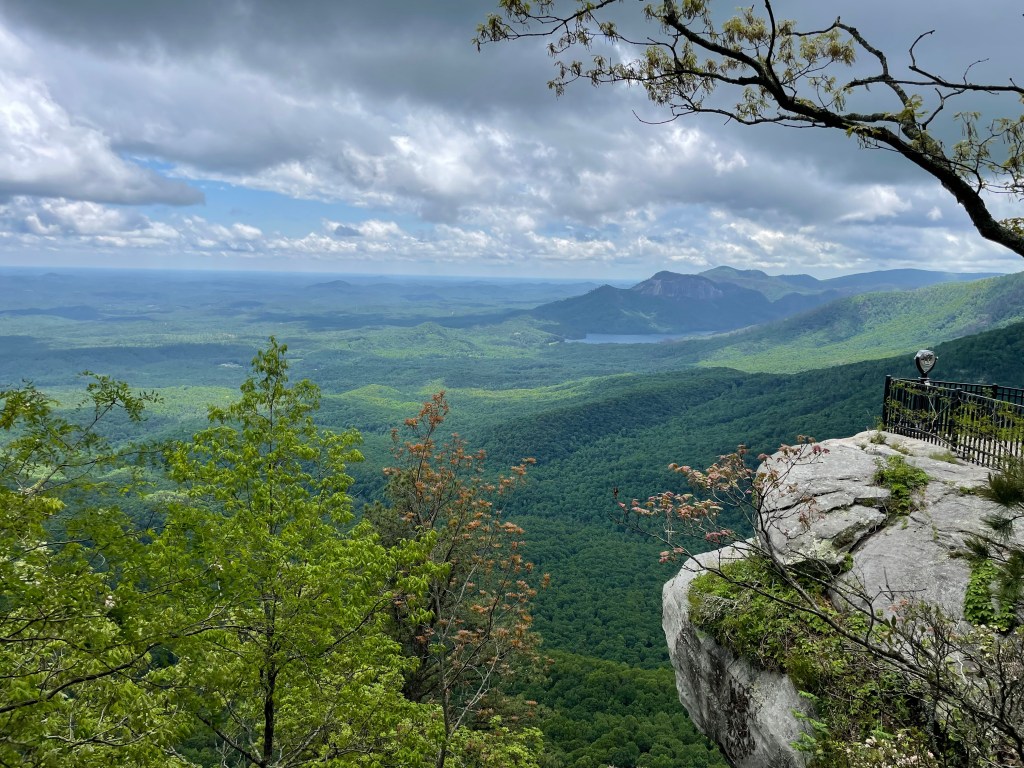
Nobody said much about Caesar’s Head online. For me it was just another place to stop so I could say I had been birding in South Carolina. The problem was; this place was beautiful. The stone visitor center sat atop a towering rock face with an observation deck looking over the tree covered hills below. A large lake shimmered in the distance and behind me, across the road, was a solid forest of tall deciduous trees with a newly leafed, bright green canopy. It was breathtaking.
Near the parking lot I heard the soft poo-poo calls of a Black-billed cuckoo. The brush was so thick I couldn’t get a good look and the bird only gave one series of calls. I doubt that sighting will get confirmed.
A short conversation with one of the staff revealed a trail across the road. I walked about a half mile down the wooded trail. Hooded Warblers were calling at regular thirty yard intervals. I had only ever had a couple of these species in front of me prior to this. It was clear I was someplace new. Then I heard a new warbler call that wasn’t familiar to me ringing through the woods.
Merlin indicated a Swainson Warbler (L8). I checked with recordings from the Sibley app and it was a match. There were at least three that I heard calling. I couldn’t find a single one of them. I was counting this as a lifer but I was hoping to eventually see one. I wanted to keep walking on this lovely little trail down into the wooded valley to see what else awaited me. However, with great reluctance, I turned back and made my way to the truck.
Caesars Head SP – https://ebird.org/checklist/S237991809
The next day I went to Roan Mountain State Park in Tennessee which was probably my last chance to see a Ruffed Grouse.
I went to the Gristmill Trail behind the visitor center primarily because I didn’t know where else to go. Nobody at the visitor center had any idea where to find a grouse. I’m not even sure they knew a grouse was a bird until I mentioned it. I’m not fond of when visitor center employees don’t know anything about the park in which they work. However, I’m sure their pay sucks so their engagement level is probably low. They are just killing time until they can get home and binge the next season of Stranger Things, on which they probably have extensive knowledge.
Setting out on the trail behind the visitor center, the trees here were amazingly tall. Not redwood or Amazon Rainforest tall, but taller than most deciduous trees. I’m guessing this was a relatively undisturbed forest. Then again, I think the visitor center was an old lumber mill so maybe not. Either way, it was otherworldly. I had been in the Appalachian Mountains in Tennessee before but I don’t remember such tall trees. Perhaps I didn’t notice. I wasn’t a birder then so I doubt I looked up much or maybe this area was simply special in that way. I was thankful at the chance to walk in such a presence.
The trail was muddy and extremely steep in places. It felt like they just let a guy loose with a chainsaw and that was as much forethought as the project was given. Still, it was a nice morning walk in the woods and I was glad to have any kind of a path to follow.
The warblers and vireos were singing from all quarters. I found a few brown creepers and it’s always a pleasure to hear the woodpeckers out east. As seems to be my luck though, the grouse would elude me. It’s part of a nationwide grouse embargo against me. I’ve yet to find a Dusky Grouse in my home state despite trying many times. I really don’t want to talk about it.
I think I blew my chance by being much too low in elevation. The higher portions of the park would have afforded me a much better opportunity to find this bird.
Roan Mountain SP – https://ebird.org/checklist/S238401999
Virginia & Kentucky
I had decided to stop at Breaks Interstate Park which straddles the border of Virginia and Kentucky. I thought this would be a throwaway location but it actually turned out to be fairly active. I heard a Palm Warbler near the entrance and then went to the first hiking trail I could find. Hooded and Black-throated Green Warblers were busy singing here. I didn’t bother to try and see any. I quickly developed a new interest.
I had keyed in on some Swainson Warblers that were calling. This was probably my last chance to see one as my path would keep taking me farther north. The only problem was that they were on top of the hills and I was in the valley between. The undergrowth was thick so there was no way to get to them. They would hear me coming and move long before I caught a glimpse of them.
The warblers were spread apart by about seventy yards. That was a pretty large span of territory that they each monitored. There was only one thing I could try to bring them off of the hillside. After some deliberation, I decided to play a call.** I listened to each bird calling around me to try and figure out the areas each was watching over. I selected a bird I thought might come down on one side of the trail which I favored for a photo op.
A single playback was all it took. It has always amazed me at how quickly a bird can hone in on exactly from where a call emanates. The bird had come down from the top of the hill and was about forty feet from me. By the time the call sounded again a Swainson Warbler was practically on my shoulders in the understory next to me. I stopped playback at that point and started snapping photos. I stayed for as long as the bird was present (about two minutes) and took as many pics as I could, adjusting camera settings as I went due to the low light. As usual, the first shot I took was the best. The bird flew back up to the top of the hill, satisfied that no interloper existed, while I did a short but massively awkward victory dance.
The Kentucky side of Breaks Interstate Park was beautiful, but a waste of time as far as birdwatching goes. Unbeknownst to me, I had selected perhaps the worst location possible. The trail was right next to a rocky creek and I couldn’t hear much over the noise of the water.
Breaks Interstate Park, Virginia – https://ebird.org/checklist/S238403744
Breaks Interstate Park, Kentucky – https://ebird.org/checklist/S238404342
West Virginia
I made a beeline for West Virginia and stopped into a local brewery for a beer before dinner. Drinking at new breweries is a little past time of mine that I fit in when it’s advantageous. The brewery was a giant pole barn building completely bereft of character. That’s nothing new though, large spaces aren’t good for that and breweries nowadays have a bland and sterile atmosphere to them. I sat at a long picnic table at the end of which was an elderly couple who told me they were from Canada.
I was just in time for the bingo game. Even if you don’t know me, you’re probably getting a sense that bingo is not exactly my scene. Now if a punk rock concert broke out, that’s another matter entirely. No matter, the beer was decent and I was tending to my checklists. A guy began talking to the Canadian couple next to me and he was telling them about how he shoots raccoons with an assault rifle (his words). I shook my head. It made me wonder if he was the owner of the place. After all, there were posters for ammunition hanging from the walls virtue signalling insecurity. Welcome to West Virginia.
I was in this state for one reason. There was a spot I had an urge to visit. It was nearly on the eastern border of West Virginia. It was much farther east than I wanted to go but I was enamored with the idea of the Cranberry Glades Botanical Area. In fact, coming here was the whole reason this trip turned into a loop.
Cranberry Glades is nestled into a depression in the Smoky Mountains. This ecosystem is a peat bog and hosts a number of plants that occur nowhere else this far south in the United States. The habitat is sensitive to human disturbance so one has to stay on the boardwalk while visiting. All of this piqued my interest and since I had never been to a peat bog, it was a must see.
As it turns out, this is a great place to find Mourning Warblers as half of all checklists during spring include this species. Other sought after species also lurked here so this place had some great possibilities for me.
The drive into the Glades does not indicate that you are going to find a peat bog. Tall pine forests border the road. Even the parking lot is lined with pines. It feels more like northern Minnesota. In as few as twenty feet onto the boardwalk however all of that changes. The bog is a thick woody patch of undergrowth interspersed with trees of medium height. The boardwalk encircles the underbrush and on the outer edge of the boardwalk one can find open grassy areas. Hearing birds at this location is easy. Getting a visual on a singing bird, or any bird, is its own form of torture.
I walked slowly and tried to identify anything that moved. Birds were calling the entire time. At the back of the boardwalk there were Blackburnian Warblers singing. I wanted a great photo of one of these beautiful birds. Even though they were singing in front of me in some pine trees I could not locate a single one. Eventually the pursuit was abandoned. The birds were still far enough away that, even if located, it wouldn’t be a great photo.
In one corner of the boardwalk Merlin occasionally indicated an Alder Flycatcher. Could it be? I couldn’t hear it yet. These birds were very likely to occur here. I had stared at this species on my target list for so long. It would be nice to have a chance at finding one.
After walking more, I began to hear the calls of two Alder Flycatchers (L9). They were far enough away that they couldn’t be seen. I waited, sure that I would spot one of them flying out to catch an insect. Forty minutes ticked by, each one proving how wrong I was. After seeing nothing, it was time to move on.
I just knew I was going to find a Mourning Warbler here. However, I ended up in the fifty percent of spring checklists that didn’t include this bird. It felt like my lifer Mourning Warbler had just slipped from my fingers. If I couldn’t find one here, the chances seemed slim that I would be successful anywhere else.
Cranberry Glades BA – https://ebird.org/checklist/S238998509
Pennsylvania
I arrived at Lake Erie and did a time check. A rainout at Swallow Falls State Park in Maryland gave me the unexpected chance to bird for a bit on Presque Isle State Park before dinner.
Presque Isle stretches out into the Great Lakes like a crooked finger. Any bird heading over this vast ocean-like lake has a good chance of landing here instead to rest and fill up the tank. The literature had said this place is only a possible migrant trap. Weather conditions contribute to varying results.
I drove out onto the Isle wanting to find a place that looked birdy and had parking. It’s a busy place and sunset was fast approaching so that last part was important. There was no time to park and then wander aimlessly. That will happen tomorrow.
Just past the ranger station there was a small patch of timber bordering a mowed lawn that looked promising. I could use the lawn to walk the treeline. It was also a spot where the shore was facing the mainland. Hopefully, this was one of the sections of trees that birds would use as an entry point for this peninsula.
After walking a scant fifty feet I realized this spot was a good choice. There were around sixty warblers working this small section of tree line. For you folks who live under major flyways this may not make for much of a spectacle for you. For me though, in this one spot were more warblers than I will see all year, or maybe two, in Colorado. I had never seen so many at one time. It was a frenzy and I also assumed a frenetic role, hurriedly trying to identify all I could.
Yellow-rumped Warblers were plentiful as were Magnolias. I found some American Redstarts, Bay-breasted, Black-and-whites, a Nashville and a Palm. I also discovered that catbirds here mimic Yellow-bellied Flycatchers well enough to trigger them on Merlin. I wondered if the rest of the park was this birdy and what I might find tomorrow.
Over dinner that night I looked at all of the bird reports and decided to go out the next day to try for an American Woodcock. I thought about going out that night. However, it was already dark and I had missed the prime time near dusk. I was also tired and just wanted to shower and crawl into bed. I was still recovering from my zombie state of being. I would have more chances to hear this bird later in the trip.
The next morning I went out and hit the spot with the most American Woodcock sightings. I covered as much ground as possible and walked through a few areas hoping to flush a bird but it was not to be.
Throughout the morning, I checked out a couple of different spots on the isle and ended up in a big group of Bay-breasted Warblers and a number of good sized flocks of Magnolias. On the Sidewalk Trail there was a report of a Mourning Warbler. I worked my way towards the spot and then back but there was no sight or sound of the bird. It was my second strike out for this species, both times where one or more had been reported prior. Was I ever going to see one of these damn birds?
Meanwhile back home, a single Mourning Warbler showed up and birders were adding this to their checklist. This is an extremely rare bird for Colorado. It would have been a trifecta for me. A lifer, a new state bird, and a county bird. It used to be that on vacation I would just not check bird reports from back home. Now half a dozen bird chat groups are blowing up my phone, the updates have become unavoidable. Because of this, I have learned to live with the choices I make, especially during migration. There is no way to be everywhere at once. I’ve learned to not regret the birds missed while out looking for others.
Ranger Station – https://ebird.org/checklist/S238998406
A Trail – https://ebird.org/checklist/S239145423
Sidewalk Trail – https://ebird.org/checklist/S239245411
Ohio
I left Presque Isle and ventured into Ohio continuing my way along the Great Lakes. I was to rendezvous with my friend Winston, who flew out to meet me, at the famed migrant trap Magee Marsh.
I didn’t know what to expect from this location but I was looking forward to finding out. Winston already had boots on the ground and had been birding there while I was in-route. When I arrived, I parked near a hedge row that had more people walking around it than birds in it. So far on my trip I had only encountered a handful of other birders. I was about to have the situation reversed in a major way.
Winston suggested our route and I, having been there all of thirty seconds, went along for the ride. We were photographing a Blackburnian Warbler beside the parking area when we caught word that there was a Golden-winged Warbler ahead. This was one of my must see birds for this trip as I knew chances would be few.
We clambered through the brush to where the bird was last seen and joined a handful of birders already scanning. A few Yellow-rumped and a Northern Parula were seen but no Golden-winged Warbler. After a time, we left and made our way to the boardwalk.
The boardwalk at Magee Marsh is about eight feet wide and is elevated from the ground by about three or four feet. It has high railings on each side and was definitely built as a corral for people. During migration, the boardwalk is packed with birders. I would guess there are one thousand or more birders on the boardwalk at any given time. Watching where you walk, and more importantly where you stop to put glass on a bird, is definitely a matter of good manners.
Shortly after entering the boardwalk I saw another birder who was a young transwoman birding by herself. I told myself I was going to get to know her. After all, she was family and I wanted her to know she wasn’t out here alone. As queer folks we need to look out for one another.
A nearby warbler we were both trying to see presented an opportunity to introduce myself. I’ll call her Allie. We began talking about birds. What birds she had seen, what ones we had been able to find and so on and so forth. Allie was a biologist and specialized in entomology. So naturally we got to talking about insects as well. Then somehow in the melee of the boardwalk we were separated. Having made no agreement to stay together during our chat, Winston and I went on birding.
A short while later a warbler caught my fancy. The coloration was one I had never seen before. It was flitting around in some willows that touched the board walk. Of course it was on the backside of the willows and didn’t like to sit still so trying to get a great identification was difficult. I alerted Winston to the bird and told him to get any photo possible. I didn’t clue him in right away as to my suspicions, but I had already seen enough to begin thinking we had a Golden-winged Warbler.
The bird finally perched for a second and I could see its head. It was indeed a Golden-winged Warbler (L10). I felt extremely lucky having missed this bird upon my arrival. Even if this place yielded me no additional lifers, I felt this bird was worth the cover charge (there is no fee to visit here, I’m just being cute).
Shortly after this we bumped into Allie again and she asked to continue birding with us. We finished out the evening looking at birds together. We saw a Screech Owl, some nesting Green Herons and about six species of warblers. With the sun dropping behind the earth (relative to us that is) I exchanged numbers with my new friend and bid her farewell. Winston and I set out to grab a meal and a beer before calling it a night.
At dinner we discussed tomorrow’s plans. Winston wanted to try and find a Black-billed Cuckoo and perhaps the Connecticut Warbler that had been seen in the area. A plan was made for the next day, we would try the Ottawa National Wildlife Refuge next door first. It would give us a chance to bird without as many people and then we would return to Magee Marsh.
The next morning at Ottawa there were a few highlights. There was a Gray-cheeked Thrush singing very near us which was a beautiful sound and we saw a Screech Owl snoozing under the canopy. It was a fun side excursion but it was clear that Magee Marsh was where the action was.
Once back on the boardwalk at Magee we had the good fortune to see a Blanding Turtle basking in the sun. This species is one that is being monitored from a conservation standpoint. Though I had never heard of this turtle prior to this, I appreciated seeing a threatened species that wasn’t a bird.
Soon after, an epidonax flycatcher call caught my attention. I looked down at Merlin, which I kept running almost continuously, and it indicated a Yellow-bellied Flycatcher (L11). After a little scanning I was able to see it sallow out to catch insects. Back on its perch we could just barely make it out over the tops of the willows. I was able to get a photo but given its distance, I doubt I would be petitioning to adorn the cover of any magazine except “People Who Think They’re Photographers Monthly.”
With hoards of people at Magee Marsh during migration there is an advantage that can be had. People group up to look at birds of interest. One can simply walk along and ask each group of people what bird they are on. We quickly began doing this in order to see if we also needed to stop and look or if it was a species we already had. Generally, the bigger the group the more important the bird may be.
Winston happened upon a group of birders slightly before I did. He came back to me and said “it’s a Mourning Warbler.” I was intrigued, in fact I think my exact words were “holy shit!” As folks left the group, we worked our way along the railing and began gathering information about where it was sighted and how long ago. By the way, the answer to the question of when a sought after bird was last seen will always be, “right before you showed up.”
There were a group of folks about twenty feet from us who thought they had a glimpse of it. I thought about moving to their location but I knew the bird had been seen where we were. I began scanning the thick underbrush to try and get an idea about where good viewing windows into the thicket would be and how deep into each opening I could see. I was also assessing how large objects were in the brush trying to get a sense of how big or small this bird would appear in relation to its surroundings. I knew I would probably only have one chance to see this bird and I was trying to tick off every box ahead of time to ensure success.
We found multiple birds moving through the underbrush but not the one in which we were hoping. Then around the forty minute mark I caught a glimpse of something. I raised my camera and saw a dark gray bird. It wasn’t a clear view but it looked promising. I let folks know that I may be on it and where it was. I never took my lens from the bird. Then it happened. A quick about face allowed the yellow underside of this bird to shine. I said “that’s it” and began taking photos whenever I could. Winston was on the bird as well as a couple of other people from the group. Unfortunately, not everyone would find it in time before it disappeared back into the recesses of the marsh. Total viewing time was approximately thirty seconds and the bird did not sit still the entire time. Luckily, a couple of my photos provided definitive verification. I finally had my Mourning Warbler (L12). To this day, I have yet to hear one vocalize.
There is speculation that the Mourning Warbler and the MacGillivray Warbler may be the same species. Given how hard I worked for the Mourning Warbler I selfishly hope that isn’t true.
Back near the parking lot we went to try and find the cuckoo. Surprisingly, it flew up into view on the edge of a small cluster of shrubs shortly after our arrival and just sat there in the sun while we got some great photos. Apparently, this bird isn’t aware of its reputation as a recluse. A family of birders came along and we put them on it before leaving.
Around one hundred people were in a group fifty yards away from us looking for the Connecticut Warbler. A few would report seeing it but not many. Winston didn’t want to wait around for hours for the remote chance to see this species. I was in agreement. He had a flight to catch and I was Michigan bound.
As I drove away, something didn’t sit right with me. Had I seen a Connecticut Warbler before? Yeah, of course I had. I have all of the warblers named after states. I put the thought out of my mind. This, my feather loving friends, is what they call foreshadowing.
Magee Day 1 – https://ebird.org/checklist/S239442570
Ottawa – https://ebird.org/checklist/S239656541
Magee Day 2 – https://ebird.org/checklist/S239792137
Michigan
I woke up in Michigan and checked eBird. I’m not even sure why, I hadn’t been looking at reports for most of the trip. I had an itinerary and I was following that. When I clicked on my needs list, the Connecticut Warbler popped up. My heart beat in double time, that wasn’t such a big deal as I have a condition where that happens occasionally. Then it sank in my chest letting me know the shock and disappointment was real.
How was it possible that I didn’t have this bird already? I went back through my records and found that the warbler I had seen in Colorado was a Tennessee. Given the number of folks that were gathered at Magee Marsh to try and hear or glimpse this bird, I ascertained that it must be a sought after Parulidae. I was upset that I had missed a chance to see this bird. However, there was another opportunity looming in front of me.
One of the two Connecticut Warblers was reported at Warren Dunes State Park. This just happened to be my destination for the day. Forgetfulness had slighted me but also done me a favor. As I mentioned before, I had planned on visiting Canada. However, I had forgotten my passport, and then decided not to have Winston bring it to me. I chose to eliminate Canada from my itinerary. I didn’t like the time crunch it presented. This meant that I now had additional time to look for this warbler.
I headed to Warren Dunes State Park but I had no idea how to access this park or even where this Warbler was being seen. The birders who had reported it weren’t very good about adding a location to their reports. I didn’t know anything about a Connecticut Warbler’s habits either, other than this bird didn’t generally like to show itself. I was trying to carry out a task in an information blackout. All I knew was that somewhere in this 1500 acre patch there was maybe a small secretive bird and I had a desperate need to find it.
Upon my arrival I thought I saw a couple of birders down the road but by the time I geared up they were nowhere to be seen. The place was rather birdy. I came upon the edge of a swamp with a number of warblers and flycatchers. Walking up the road farther there was a split in the trail. I could go to the lake or along the edge of the swamp. I wanted to see the lake and the dunes so I followed the signs uphill and entered the shadows of the deciduous forest where I began to hear the songs of Swainson Thrushes harmonizing through the valleys.
Near the top my pace slowed as the sand deepened making it extremely difficult to walk. I was trying to walk up a 45 degree angle and the sand would sink downhill with every step halving my progress. I live at a mile high altitude and I wasn’t out of shape by any means but by the time I got to the top of the dunes I’d had enough. My legs were heavy and burning. There was no way I was walking down the other side to the beach. That meant I’d have to walk back up to the top all over again. Since I couldn’t see any birds, there was no reason to make that trek anyway. The view was great from here.
The sandy dunes had sections of short woody growth and patches of grass throughout. The sand sloped down to the water’s edge to meet the waves of Lake Michigan while at my back was a hardwood forest. The soundscape was a mixture of crashing waves and serenading thrushes. After soaking up as much of the scene as I could, I turned around and made my way back down to the swamp.
I walked a trail that encircled the wetland. It was difficult to see into the thick, woody vegetation. I did find a Wood Thrush on the ground and got the best pics I have of one yet. It wasn’t a high bar to clear.
I was lingering in an area and bumped into another birder. He said this was the spot where the Connecticut Warbler had been frequenting. He also told me about the other Connecticut Warbler which was active and singing near a boardwalk at a place called Kesling Preserve about thirty minutes away. That sounded more promising than what I had found so far. I stayed for another thirty minutes, saw nothing, and then decided to try the other location.
Warren Dunes SP – https://ebird.org/checklist/S240208930
After arriving at the Kesling Preserve there was a platform structure which began at the road’s edge and then had a stairway descending about ten feet down to the trail. It wasn’t a boardwalk. Was this what the birder was referencing? I didn’t know, nor did I exactly understand where the bird was in relation to this structure. Maybe that’s why the birders here didn’t include location details in their reports. They were bad at it. As I descended the stairs and stepped onto the trail there were virtually no birds singing here. I lingered a bit but once nothing sang I decided this wasn’t the area and began walking down the trail.
On one side of me were boundary signs for a landfill (the birder had vaguely mentioned this) and on the other a creek. This place wasn’t well visited and the trail was hard to follow. Along the creek I saw a few Louisiana Waterthrushes and heard a couple of Alder Flycatchers.
I noticed Merlin started indicating Blue-winged Warblers. I hadn’t seen one yet, perhaps it was a mistake. Then I heard a buzzy call that I wasn’t familiar with. I started looking high and was able to locate a handful of Blue-winged Warblers (L13). These birds were not interested in coming down out of the canopy. I gave up on trying to get a closer look at one and continued down the trail.
I was busting through brush attempting to find any semblance of a trail, while simultaneously trying to avoid poison ivy. There was no way most folks walked this far. Eventually, I lost the trail completely, admitted defeat and turned around.
On my way back I found a Blue-winged Warbler low. I waited for this one and was able to finally get a photo of half of this beautiful bird at close range. Lucky for me it was the good half which includes the head. I considered myself quite fortunate to see this life bird at eye level.
It was time for me to go. Once back at my truck another vehicle pulled up. Maybe they knew where the warbler was. It turns out it was just some workers parking for lunch. As I was leaving two other vehicles arrived. One person got out with binoculars. Birders!
They had shown up to see the warbler and one of them had found it this morning. I asked to tag along, not that I would have taken no for an answer, and we went back in. It turns out the bird was hanging out just off the road by the platform after all. I didn’t have much time left but I also couldn’t pass up this opportunity. I doubt I would have another chance to find this bird.
Suddenly from the tall trees above I started to hear a buzzing noise but it was different from the Blue-winged Warblers from before. One of my new found companions knew the score. Two Cerulean Warblers (L14) were noisily calling from the upper canopy. They weren’t doing that earlier. I had hoped to get these birds in Illinois. However, I wasn’t going to look a gift horse in the mouth. You’re not supposed to do that for some reason. A Yellow-throated Warbler also entered the scene and began singing from above our heads.
One of the birders I was with was talking incessantly about the Ceruleans. He was enamored with them which I could understand. However, I had to literally shush him. “The Connecticut is singing!” I proclaimed (L15). “Oh yeah, that’s him!” the birder next to me exclaimed. We waited, hoping the bird would emerge from the thicket. If it did, we didn’t see it. It sang out again, raising my hopes of getting a visual. It was not to be though, and after twenty minutes I wished my temporary companions good luck and went on my way. Sound would have to be enough this time around.
I reflected on how fortunate I was. Just five hours earlier I had lamented missing the Connecticut Warbler at Magee Marsh. This location was not on my radar for this trip. Also, had it not been for the birder at Warren Dunes and then the other birders I bumped into at Kesling, I would have missed out here as well. I also ended up seeing Cerulean and Blue-winged Warblers. I wouldn’t encounter any of these species for the rest of the trip. Making up for my mistake netted me three lifers. I couldn’t have been happier.
Kesling Preserve – https://ebird.org/checklist/S240396586
Illinois
I awoke the next morning to a cold and blustery weatherscape in Chicago. I was excited to go to the fabled Montrose Point Bird Sanctuary. The weather was rainy with a stiff wind blowing out of the north. Perfect fallout conditions I surmised. Facing a head wind and the prospect of crossing Lake Michigan the birds were surely destined to head to the ground. After making my way through the morning commuters I arrived and realized the situation was more dire than I expected. The wind was howling out on the point. Six feet tall waves were exploding onto the shoreline and over the concrete wave breaks. The rain was being driven nearly horizontal. I knew I wasn’t going to be heading out onto the beach to try and find the Piping Plovers on a day like today. When I parked I almost didn’t get out of the truck. Who would want to? It was brutal out there.
Somehow, though I mustered up all the stupidity I could and gave it a go. I decided to stiff Chicago the money and take my chances on parking. I didn’t want to pay to park for what was probably a waste of time. I was the only one dumb enough to be out there in these conditions anyhow so it’s not like the parking authority would come looking. Once in amongst the hedge rows the wind was less pronounced. There were a few birds present, I was able to log some new state birds, but no fallouts were occurring here today. I’m sure this wind forced birds to the ground, but it likely did so miles south of me. Come to think of it, that sounded like a good plan. I tucked the wind beneath my tail feathers and headed south as well. I had one guaranteed lifer yet to see.
Montrose Point BS – https://ebird.org/checklist/S240561802
When most people drive over the I-90 bridge acting as the go between route for Indiana and Illinois they are unaware of two things. First, viewed from below, those bridges look sketchy in terms of stability. Second, they are driving over a Monk Parakeet colony.
I actually didn’t know exactly where the nests were. Upon arrival I was looking for nests built on telephone poles as one picture online seemed to indicate. I parked on the street when I passed my GPS pin on the map. I figured I would get out and walk around the neighborhood a bit to try and find these nests. No need. As soon as I stepped out of the truck that familiar Psittidae scream emanated from multiple birds.
Looking back at the bridge it was obvious as to why. Where the old rusted steel support beams met the substructure of the bridge it was lined with Monk Parakeet nests. These are massive hulking nests built of sticks with woven round entrances. The birds were flying to and from the nests (L16). It was quite spectacular.
Parrots have a sad story with a small silver lining. In their native habitats they are declining in many cases because of the pet bird trade and habitat loss. A few species which have been released or escaped into cities far outside of their normal range are now establishing small urban populations which are growing in size.
Who knows how many birds are actually in this colony. I could hear far more than I could see and the calls were echoing out from under the bridge. I carefully counted the birds I saw and conservatively estimated the calls heard taking into account their proximity, duration and overlap and then expertly settled on seventeen as a wild guess.
Monk Parakeet Colony – https://ebird.org/checklist/S240586174
After this, I headed down state to visit my parents, I had two more lifers to try and find. One was an American Woodcock and the other a Chuck-wills-widow. To be fair though this is where my loop and my hectic timeline ended. My schedule here on out was far more relaxed.
I went out a couple of nights to try and hear both of these species. The Chuck-wills-widow is not a common bird in central Illinois but for whatever reason one had taken up summering along a rural road. To be fair though, all roads are rural where I’m from.
The first night I had a number of Whipoor-wills but no other nightjars. Last year I was too late in the year to hear this bird. Now it was migration, I couldn’t be too late this year but could I be too early. I decided to head out the next night, as it was my last chance to find either of these species. I hit up the locations for American Woodcocks but only heard nighthawks. It made me wonder about mistaken ID’s since the two species have similar calls.
Arriving at the Chuck-wills-widow location I parked on the lane, rolled my windows down and turned off the truck. I sat in the dark and waited. I listened to a few Whip-poor-wills call from far away and sat amongst the insect conversations happening all around me. After twenty minutes or so a nightjar burst into song close by. After listening to a few calls I thought “oh my gosh, I think this call is different.”
I know what you’re thinking. If it is a Chuck-wills-widow then of course the call is different, in fact it is super distinctive. Prior to this encounter I would have thought the same. However, this bird was unique. The calls seemed fast, higher pitched and more garbled. It sounded similar, but not exact, to the Whip-poor-wills already singing. Just to eliminate my incredulity I put Merlin to the task and sure enough. Here it was (L17). I got out of the truck and began walking down the dark lane. I stood right across from the bird (maybe sixty feet away). It was loud and kept calling for a couple minutes. I had to wait a year for a second chance at this bird. I just stood there and basked in the glory. After it went silent, I heard the call again but far off in the distance. The bird had moved. It seemed as if it was perching here and there looking for the same thing I had been, a Chuck-wills-widow. I wished it as much success as I had on this night and left with my recording in hand.
Whip-poor-will Spot – https://ebird.org/checklist/S241388943
Eventually, I was able to see at least one individual of every life bird on this trip except for the Chuck-wills-widow and the Connecticut Warbler, which I claimed on sound alone.
This trip cemented my notion that birding in the south and the midwest is vastly different than in Colorado. Under the continent’s busiest flyway, I felt like James Audubon out here killing them, uh, I mean it. The main difference here was all of my birds were real.
In Colorado if we get a Bay-breasted Warbler, for instance, it may be the only one we get for that year or longer. Nearly everywhere I went in the middle of the country was packed with warblers. It was a great experience to have and it made me realize just how easy birding could be. It also makes me appreciate the hard won lifers I have in Colorado.
Now that I’ve seen these middle states there are only a few I will return to. I still need some specialty birds. The Kirtland Warbler, Great Gray Owl, Hawk Owl, American Woodcock, Smith Longspur, and Snowy Owl rank among them. As long as my parents are around, I will have a reason to come back to Illinois and the surrounding area. In the meantime, this trip was highly successful and exceeded my expectations in netting me 17 of my much needed lifers. It was one of those experiences of a lifetime and, despite a few hiccups here and there, I ultimately had a great time. If I had the chance to do it again . . . I wouldn’t.
This was a crazy plan, but it was my crazy plan and now it is over. If done again I would allow more time in each state and focus on quality over quantity. After all, maximizing enjoyment is my true goal of bird watching. Now if you’ll excuse me I have to go see this bird over here because without this extra county tick my year will be ruined.
Have a merry migration and a happy fallout.
Here is the trip report which contains far more locations than listed in the article. It is also an easy way to see all of the photos I uploaded from the trip – https://ebird.org/tripreport/363665
Footnotes
* Later, a local birder would find me online to use the photo in a state database chronicling the birds seen in Arkansas. Also, the management agency for the prairie reached out to possibly use my photos on their yearly report. I certainly didn’t expect any of this while I was out snapping pics of birds. It was nice to feel as if maybe I was contributing to something positive (however small) for the birding community in this area.
** This and the Canada Warbler was the only time I used playback for a bird on its nesting ground. For those that don’t know it is a best practice to refrain from playback as it puts the birds into defense mode. Each time a call plays, the bird spends energy looking for the invading bird (i.e. the birdwatcher using playback).
This is why I used playback only twice and kept the calls short. Many of you may think that even playing a call once is going too far. I won’t argue that point. I also don’t regret the approach I used. It accomplished my objective and while it did put each bird on alert, it was for a single occurrence and for the shortest time possible
I would never do this back home. I live in Boulder County Colorado where each month about 500-600 birders submit around 2500 checklists. When I go out birding, I can guarantee I will also find another birder. If every birder used playback when birds were nesting, we would be fatiguing birds and likely contributing to their deaths. I was in the rural south and the midwest, few people are outside much less birding here. It was days before I bumped into anyone. Another example is back where my parents live in Illinois. I often arrive to see a blank eBird explore screen because no one has logged a checklist in the last 30 days. Location matters greatly for helping me determine when and whether to use playback.

 birdcore