It is slightly before 10 pm and I have just arrived in a small, rather depressing town (just like every other town) on the plains of Colorado.
It’s one of those areas where the main show of wealth appears to be how much junk you can accumulate on your property. Some folks are weathering the recessions just fine.
I pull into the only open gas station to top off with fuel. Next to me are three trucks full of young kids. Trucks nicer than kids can generally afford. I always expect to get hassled in situations like this. I forget that I’m not young anymore. To them I’m invisible, just another old person. As I leave, I notice that at least one of the vehicles is adorned with truck nuts. Of course it is, why wouldn’t it be?
I park down the street at a hotel. As the lobby door closes behind me I hear the labored moan of spinning turbos on diesel engines fade away. The disheveled hotel clerk checks me in and has to help me with my door. Apparently, all it takes to open is a swift shoulder check. He acts like I should have known that, as if every hotel door opens this way.
Most of the things in the room are broken in one fashion or another. I see a vent on the bathroom ceiling except that the switch to turn it on has been removed. This is, I should note, exactly the type of features I look for in a bathroom fan. When I turn the water on for the shower, the handle almost falls off in my hand. Just as well I think, the mold growing out of the shower caulk has me a bit concerned for my safety anyhow. Hopefully the fungi sees that as a feat of my strength and will leave me be during my shower. The rooms are always the second worst part of being out here.
Politics are the worst part of being out here. It should be noted that the people are nice enough on the surface. As long as you only talk about the weather, you’ll be fine. Delve deeper and you’ll see that thin veneer of nicety fall away. I grew up in a place like this. Now as a trans person, I fly under the radar in rural areas for my safety. All it would take to put me in danger is one person who can’t cope with their insecurities. This topic deserves more attention as it pertains to queer folk in outdoor spaces, but for now I digress.
Truthfully, if you were to look around the so-called grasslands of Colorado you would see that not much lives out here and with good reason. As soon as a blade of grass rises from the dirt, a farmer puts three cows on top of it. There are giant reservoirs here that are bone dry and full of tumbleweeds. If this is all that the plains of Colorado had to offer I would end the story here. I would go home and this article would motivate no one to come here (and perhaps that is still the case).
However, among the desolate, dry, overgrazed madness that reigns supreme there are small areas which hold more life than others and in these places, are birds. There aren’t many incredibly special species that reside out here, but the chance for vagrancy is always present. In a land full of nothing, a creek or a playa, even a human created irrigation ditch can create an irresistible stopping point for birds. It’s not a guarantee that you’ll find something special in any of these so-called migrant traps, but your odds are better.
Even in the off season when the creeks, rivers, and ditches are dry, the tree growth they afford towers above the scrub. This can offer insects a home and the birds a place to eat and rest.
Previous birds to this part of the state have been a Red-faced Warbler, Cactus Wren, Harris Hawk, Crested Caracara, and a Golden-fronted Woodpecker. These are the species I can remember from the last two years. I’m sure there have been others. As human driven climate change continues many folks, myself included, suspect these and other southern species sightings will become more frequent.
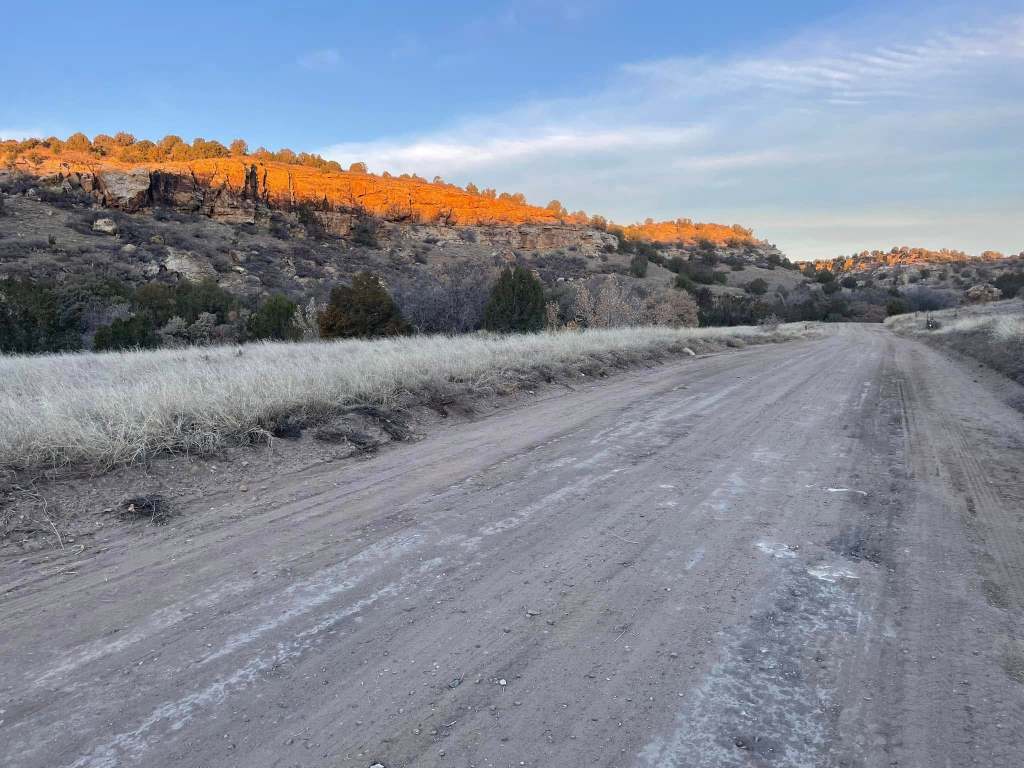
Two hours before sunrise, I set out for my destination which is called Cottonwood Canyon. On the approach, I was beginning to doubt this canyon’s existence. There are no rocky outcrops signaling a terrain change as happens with other canyons. Instead, cholla cactus and rubber rabbitbrush stretch out in an endless array as an occasional juniper breaks up the monotony. The smooth horizon is relatively uninterrupted and I soon discover why. As the dirt road continues, it drops down into the hidden canyon. A nifty little trick if I do say so myself.
Cottonwood Creek, which carved this canyon over millions of years, is reduced to a series of puddles in December. Even here, in the southern part of the state, winter is creeping in. A skiff of ice has started to form on the water’s surface.
I’m here to try and relocate a Crissal Thrasher which is a first state record for Colorado. Only a few folks have been able to find it. Then again, only slightly more than a few folks have come looking for it. The odds are not in mine, or anyone’s favor, but long shots can pay off. After the six hour drive to get here, I’m definitely hoping for a reward. Birding is putting yourself in the right place at the right time, and then hoping for a little luck while you’re there.
I have seen a Crissal Thrasher previously, but never in my home state.
As the sun rose over the plains the first rays of direct light started to glow on the top of the canyon wall behind me. It was a very memorable and welcomed sight, both because of the visual it provided and for the promise of heat.
By now another birder had joined me. Normally, I welcome help in finding a bird. However, thrashers can be skittish and elusive. I figured my best chance was to be quiet and to be by myself. No matter, as a person they were plenty nice and who knows, another set of eyes and ears could be helpful after all.
Eventually, we walked up a hill to a plateau surrounded on three sides by rock walls. Perhaps that makes it an inverse plateau. It made the triangulation of sound difficult as the bird songs were bouncing off the walls.
While standing shoulder to shoulder, we saw a bird quickly fly by and land in some waist high bushes. My enthusiastic compatriot said “that was it, it had a long tail!” We were in Curve-billed and Sage Thrasher habitat and it had flown from a spot where Canyon Towhees had been calling. The field guides say this species runs, rather than flies, from predators. I remained unconvinced of our sighting. Perhaps they had a better look at it than I did. For me it was not enough proof. I needed to see the bill, throat stripes, or those orange undertail coverts. Later, I saw more Canyon Towhees flying from that same area to where we had seen the bird land previously. This added to my skepticism.
They got their lifer and I did not add the bird to my state totals.
After a couple of hours I decided to give up on the Crissal Thrasher. I was happy with my effort and content to let this chance pass. Other birds of this species will eventually show up closer to home. Even if they don’t, life will somehow keep going.
I went back down to the canyon road and walked it for about a quarter mile in each direction. I had heard from multiple folks that Rufous-crowned Sparrows could be found here and I needed a sighting for my Colorado list. Sure enough, numerous Rufous-crowned Sparrow songs rang out from the canyon walls above me. Simultaneously, one landed about fifty feet from my position. Farther down the road I found a winter wren feeding among the exposed tree roots in the creek bed.
There was no need to salvage my day. I met a new birder, gained a state bird, and went to a place that very few folks will ever see. You don’t get here by accident after all. Afterwards, I drove another ten miles south into Oklahoma and logged my first ever checklist. From there I went into Kansas and did the same. I still have quite a few states in which to check off of my birding list. For now though, that’s two more down with only forty other states remaining.
Another great experience is in the books, and to think that it happened out on the plains of Colorado.
Rarities:
Sandhill cranes flying over Oklahoma.
Winter wren (not flagged as rare but I’m counting it)
High counts:
20 Chestnut-collared longspurs in Kansas.
Checklists:
Cottonwood Canyon – https://ebird.org/checklist/S205498138
Article soundtrack (bands):
Burn, Burn, Burn
The Dollheads
 birdcore